


Over the past 20 to 30 years, many different innovative methods have been invented to remove diseased veins with varicose veins.If before phlebologists used only classical surgery for this purpose, today they already use biological glue, laser, steam, radiofrequency intervention and much more for this purpose.
The great advantage of modern methods of removing varicose veins is that almost all of them are minimally invasive: they are performed with minimal surgical intervention (using an injection, a puncture, a small incision) and do not require a long postoperative recovery.
Therefore, in our article today we will talk in detail about how varicose veins are removed using modern methods and consider their main disadvantages and advantages.
Radiofrequency intervention
This method is especially popular in the United States of America and has gained such popularity due to the fact that after this procedure there are no scars or scars left on the body, as, for example, after laser vein removal.In addition, the advantage of this method over laser coagulation is its safety for the most sensitive and delicate parts of the body (genitals, face).
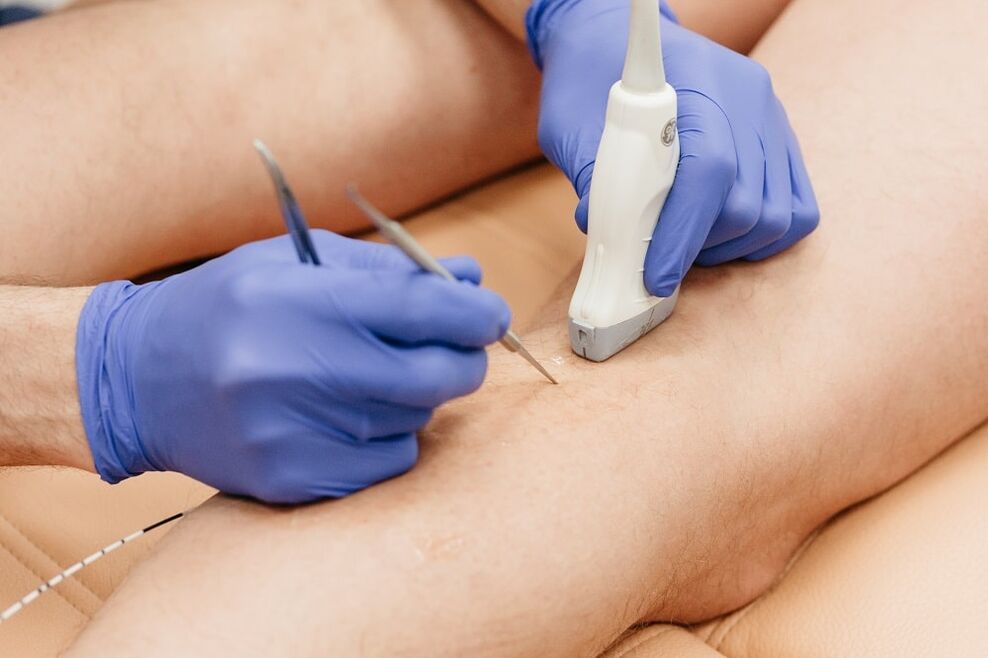
The principle of endovenous radiofrequency surgery is extremely simple: through a small puncture, a special catheter-electrode (it looks like a long but thin cable) is inserted into the diseased vein, at the end of which there is a special nozzle 7 centimeters long, which emits radiofrequency energy, heats the veins and causes them to stick.The operation is performed under the control of an ultrasound machine, so the doctor fully controls the progress of the procedure through the monitor at all stages.
The main advantage of radiofrequency catheter ablation is that it can be used even on the most vulnerable parts of the body.Another advantage is that after the operation it is not necessary to take painkillers and, in addition, the procedure itself is not very painful.
A significant disadvantage of such an intervention is the price, it is an order of magnitude higher than that of the same laser coagulation, so this technique in the post-Soviet space, when removing varicose veins, is used relatively less frequently than in the United States.
Bioadhesive Venaseal
This innovative technique was invented in the USA and has been successfully used in 5 countries since 2010. This procedure is absolutely painless, does not take much time and is performed on an outpatient basis without any pain relief (no need to go to the hospital).Once completed, you can immediately return home and mind your own business.
In the process of minimally invasive intervention, a special catheter is inserted through a puncture into the affected vein and filled with bioglue.The entire procedure is carried out under the full supervision of a doctor;Observe in real time through an ultrasound how diseased veins join together and become connective tissue.The operation does not cause any harm to the body, nor does the bioglue itself, since it is an environmentally friendly substance and does not even cause allergic reactions.
This technology has many advantages to eliminate varicose veins.Firstly, there is a complete absence of a rehabilitation period;After gluing the veins with bioglue, it is not even necessary to wear compression stockings, as is the case with most other minimally invasive methods of removing enlarged veins.The person can immediately after the end of the operation go about his business.
Another advantage of this method is its absolute painlessness and the complete absence of preliminary preparation.Visual changes become visible already during the operation, veins stick together and disappear before our eyes, the skin becomes smooth, nodules and tubercles disappear.
Among the disadvantages of the procedure we can only highlight the high cost and the fact that it is carried out only in five countries in the world, including Latvia.Therefore, not everyone will be able to afford to remove varicose veins with this method.
Sclerotherapy
A very similar method to the previous one, but less effective in relation to the main (internal) veins.In approximately 25-35% of cases, the main veins can be closed only partially, which involves repeated surgery.However, for superficial veins, those that protrude from the skin, this procedure has proven effective.
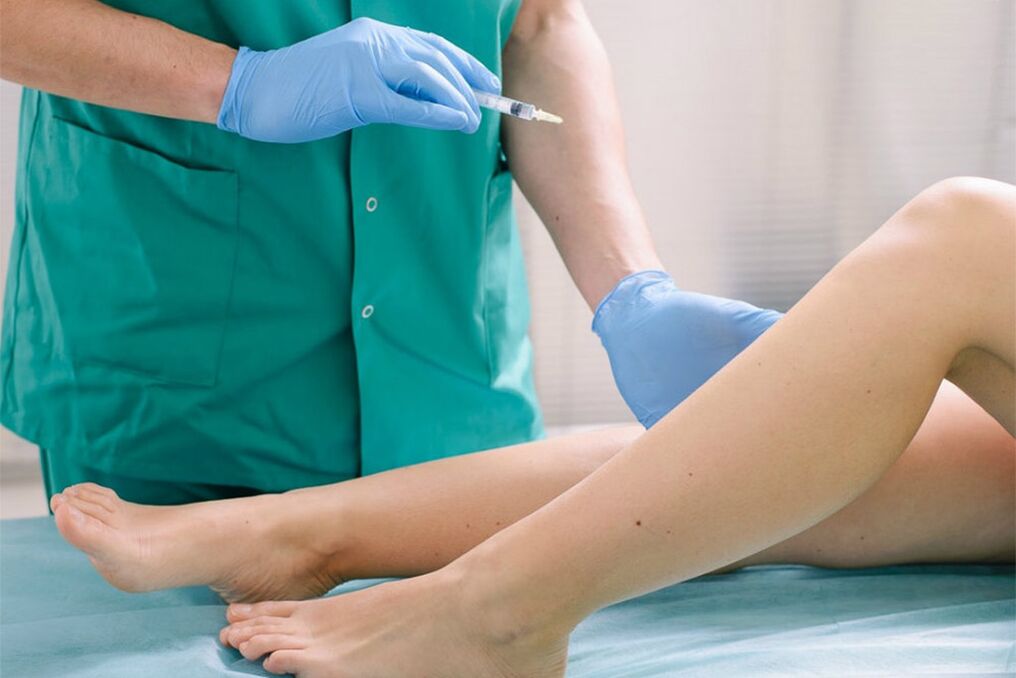
During sclerotherapy, the doctor injects a special substance, a sclerosant, into the vein affected by varicose veins through a single puncture.It is what chemically binds the damaged vein and removes it from the bloodstream.After surgery, the use of compression stockings is recommended.
The main disadvantage of sclerotherapy is that the procedure is not effective in sclerosing the main (internal) veins.Another major disadvantage of this method of removing enlarged veins is the price.
Laser coagulation
This method is one of the most popular today because it has a large number of advantages.This operation is performed under local anesthesia on an outpatient basis, after which patients are recommended to wear compression stockings for 1 month.
During the procedure, a light guide that emits thermal laser energy is inserted into the affected vein through a special microhole in the skin.The fluid in the veins heats up and sticks together.With correctly administered local anesthesia, patients, as a rule, do not experience any postoperative pain syndrome.
The main advantage of this operation is that it is painless and there is no recovery period.
There are only two disadvantages of laser coagulation: the high cost of the procedure and small scars, which in some cases do not heal even after several months.It is also worth noting that all procedures are carried out with an interval of 1-2 weeks, so if the diseased veins were not removed at the same time, their repeated removal is allowed only after 1-2 weeks.
Steam removal
It is also a fairly effective procedure to eliminate varicose veins;In Europe it is used in conjunction with the methods described above, but in the post-Soviet space it is much less common.In 2010, when it was officially recognized by the medical community at the European Phlebology Forum, it took first place as the original and highest quality operation for the removal of varicose veins.
During this procedure, a catheter is inserted into the vein through a microhole, through which controlled micropulses of heated water vapor are delivered.Under its action, the venous walls are compressed, the vein is completely closed and leaves the circulatory system.After the procedure, compression stockings are required.
The operation is performed on an outpatient basis with local anesthesia, without any prior preparation.After vein removal, you can go home immediately and go to work the next day.
Vapor micropulse intravenous thermal occlusion has many advantages.First of all, this concerns the effectiveness of the operation in complex cases, when the veins have extensive branching, a large diameter or are located on side branches (previously, these veins were removed only by the classical Varadi method).Additionally, this method can be used in case of relapses of the disease and after thrombosis.
The main disadvantage is anesthesia;It is carried out with the addition of adrenaline and can therefore place an additional burden on the heart.Additionally, in some cases, people experience a temporary loss of skin sensation and bleeding after vein removal with steam.
Miniphlebectomy
It is a minimally invasive and low-traumatic method to eliminate varicose veins that does not require prior preparation.The procedure is performed on an outpatient basis under local tumescent anesthesia and lasts about 40 minutes.Once finished, in a few hours you will be able to return home.All skin punctures heal after a while and become almost invisible.
During the operation, the surgeon makes several punctures along the dilated vein and through these holes mechanically extracts the diseased vein.The doctor monitors the progress of the procedure using an ultrasound machine.Anesthesia lasts 6 to 10 hours.
The advantages of this intervention are a high cosmetic effect and a total absence of pain.It is also worth noting that this operation is available to a wide range of people, including people with ascending thrombophlebitis, as it is well tolerated.
This method has some disadvantages: hyperpigmentation of the skin along the removed vein (rare), bruising (dissolves without a trace after a while), deep vein thrombosis (isolated cases).To prevent the development of thrombosis, it is recommended to wear compression stockings and limit physical activity in the first days after vein removal.